
How to Measure a Box
Measuring a box sounds like a five-second job. Grab a tape, write down three numbers, done. But the number of orders that come in with flipped dimensions, wrong wall measurements, or boxes built around the product instead of for it tells a different story.
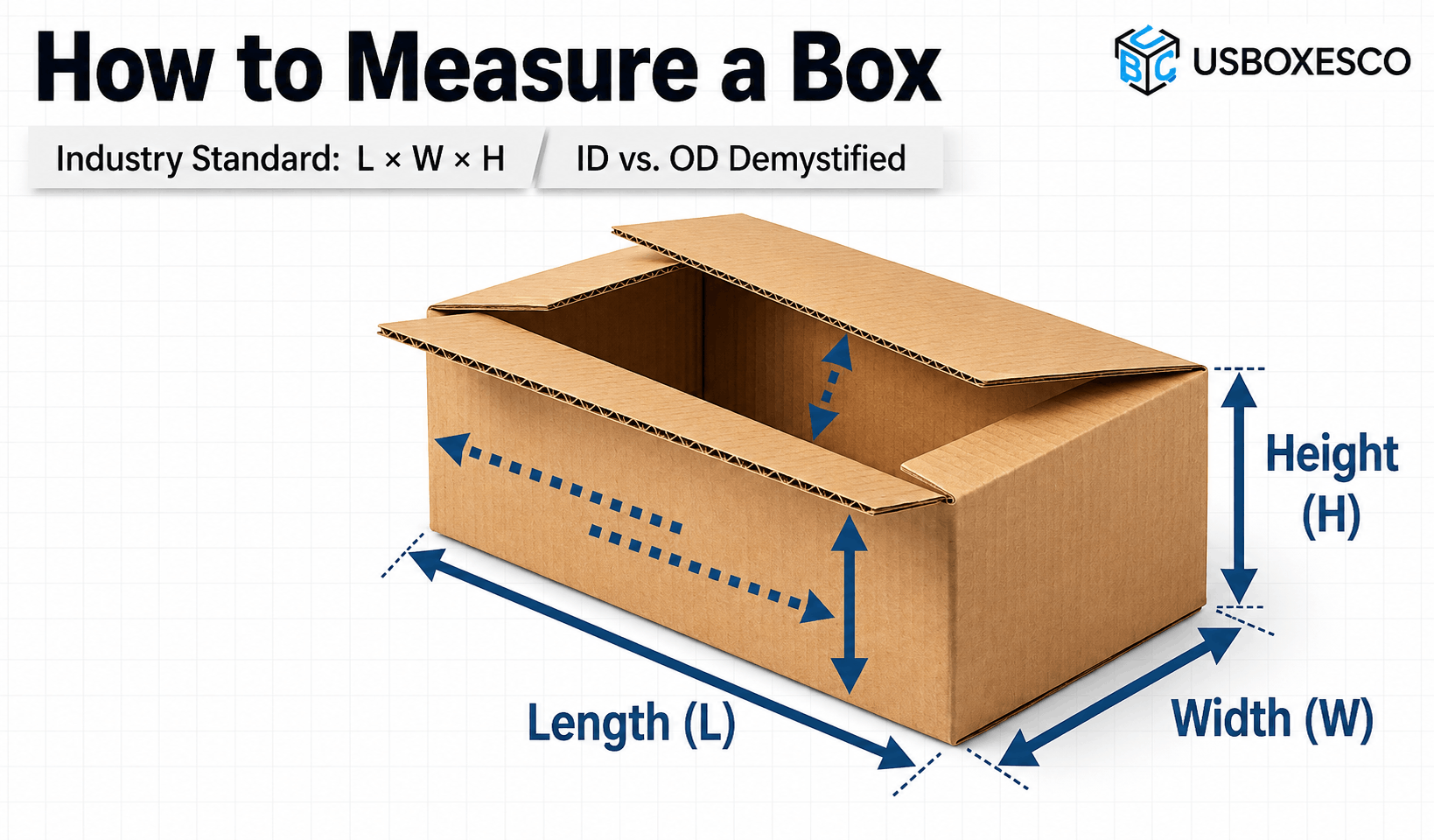
Table of Contents
- What Are the Three Dimensions of a Box
- How to Measure a Box Step by Step
- 1. Measure the Length
- 2. Measure the Width
- 3. Measure the Height (Depth)
- Inside vs. Outside Dimensions
- How to Measure a Box for Shipping
- How to Calculate the Volume of a Box
- Common Mistakes When Measuring Boxes
- Measuring the outside when you needed the inside
- Flipping length and width
- Forgetting tolerance
- Measuring with the box already collapsed
- Using soft tape on a curve
- Mixing units
- How to Measure a Box for Custom Packaging
- Measuring Non-Rectangular Boxes
- Quick Reference: Box Measurement Chart
- Final Thoughts
If you're shipping with UPS, FedEx, or USPS, the size you write down decides your shipping cost. If you're ordering custom packaging from us, those three numbers decide whether your product slides in clean or shows up looking like it fought the box on the way over. So it pays to get this right the first time.
Below is the full breakdown. How to measure boxes the way the industry does it, what each side actually means, and the small details most people skip.
What Are the Three Dimensions of a Box
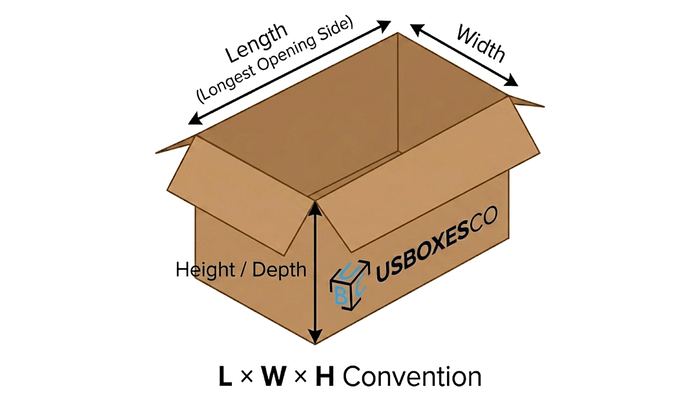
Every rectangular box has three measurements: length, width, and height. The order matters, and it isn't random. Carriers, manufacturers, and warehouses all read these dimensions the same way, so once you learn the convention you can communicate sizes without anyone guessing.
The standard order is L × W × H.
- Length: the longest side of the opening at the top of the box.
- Width: the shorter side of the opening at the top of the box.
- Height (or Depth): the distance from the bottom of the box to the top, measured straight up.
That's the convention used across the packaging industry in the US and most of the world. When you see a box listed as 10 x 8 x 4, length is 10 inches, width is 8 inches, height is 4 inches.
How to Measure a Box Step by Step
You only need a few things: a tape measure or ruler, the box itself (or the product, if you're sizing a new one), and somewhere flat to set it down. A digital caliper helps for small boxes where a sixteenth of an inch matters, but a basic tape measure is fine for most cases.
1. Measure the Length
Open the box and look down at the top opening. Find the longer of the two sides on the rim. Place your tape at one inside corner and run it across to the opposite corner along that longer side. Read the number where the tape meets the second corner.
That number is your length.
2. Measure the Width
Same opening, but now the shorter side. Run your tape from one inside corner to the other across the shorter dimension. That's your width.
A quick check: if the box is a perfect square at the top, length and width are equal. Cube boxes fall into this category. In that case, you can call either side "length" and either side "width," but the height is still the vertical measurement.
3. Measure the Height (Depth)
Set the box upright on a flat surface. Measure straight up from the inside bottom to the top edge of the opening. Don't measure the outside if you're ordering custom boxes. Always go by the inside, because that's the space your product actually lives in.
For folded boxes that come flat, the height is the depth of the side panel, not the length of the flat sheet. People mix this up all the time.
Inside vs. Outside Dimensions
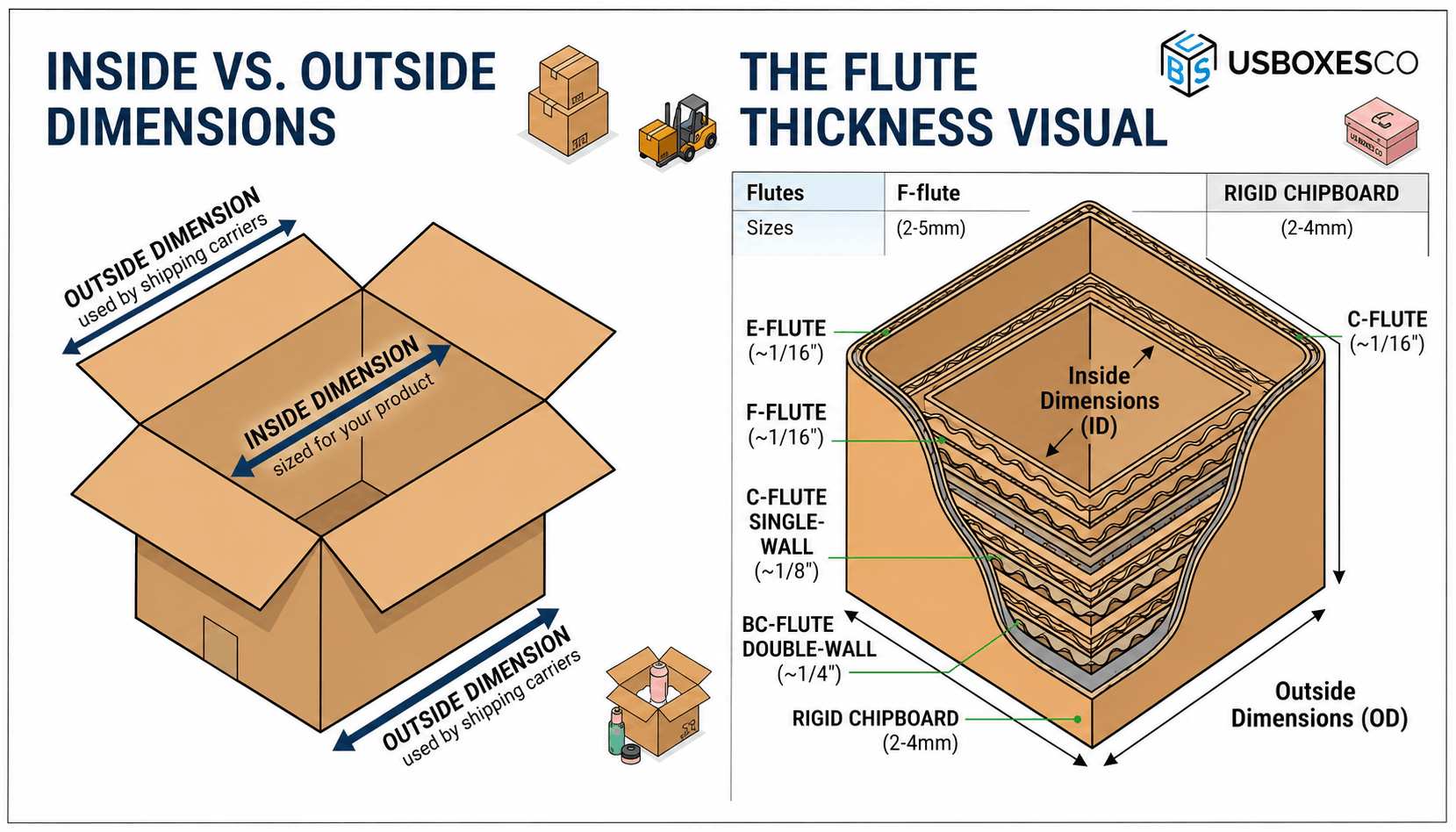
This is the part that trips up most first-time buyers. There's a difference between the inside and outside size of a box.
- Inside dimensions are what your product needs to fit into. This is what you use when you're sizing a box for your product.
- Outside dimensions are what shipping carriers use to calculate freight cost and what warehouses use for stacking and storage.
The structural difference between inside and outside dimensions depends heavily on the flute profile of your board. Slim retail cartons made from E-flute or F-flute (common for cosmetic boxes and small folding cartons) add about 1/16 inch or less to each wall.
Standard shipping boxes made from C-flute single-wall add roughly 1/8 inch per side. Heavy-duty BC-flute double-wall, used for freight and fragile shipping, adds closer to 1/4 inch per side.
Rigid luxury setup boxes add even more because the dense chipboard core runs 2 to 4 mm thick before the decorative paper wrap goes on. So a rigid box with 6 x 6 x 2 inch inside dimensions can measure around 6.4 x 6.4 x 2.3 on the outside.
When you place an order with us, we ask for inside dimensions (ID) by default unless you tell us otherwise. That way the product fits the first time and nobody has to redo a die line.
How to Measure a Box for Shipping
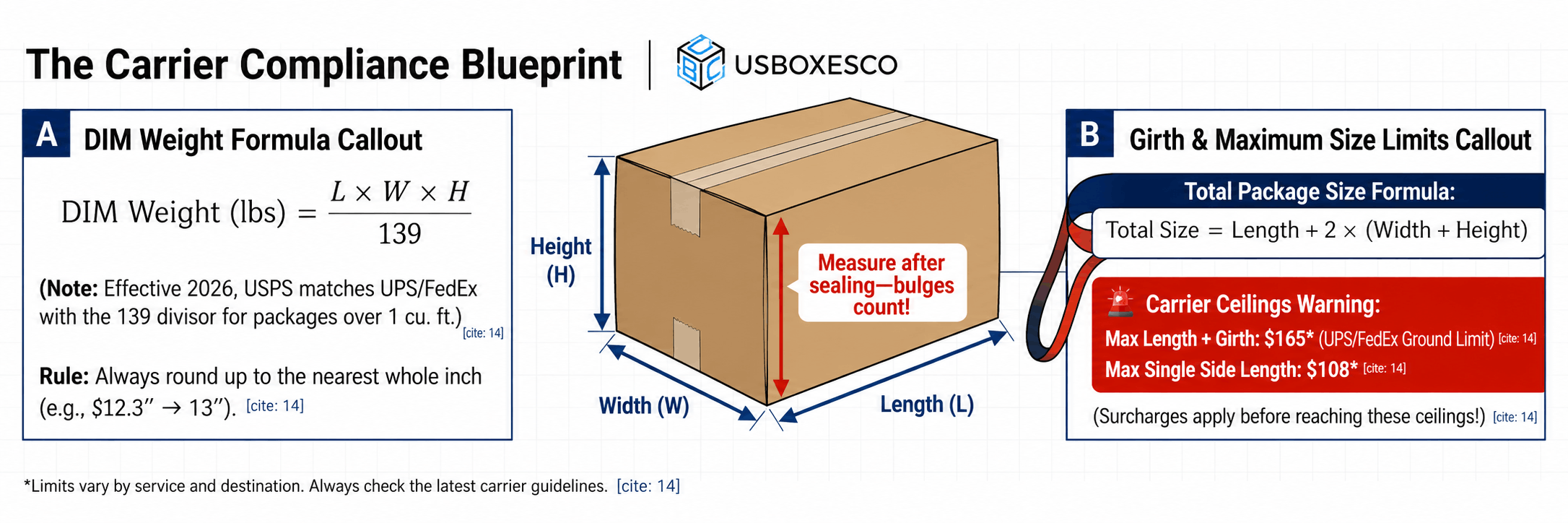
Shipping rates aren't just based on weight anymore. UPS, FedEx, and USPS all use something called dimensional weight (sometimes shortened to DIM weight), which charges you for the space your box takes up in the truck even if the box itself is light.
The formula carriers use is:
Dimensional Weight (lbs) = (L × W × H in inches) ÷ Dimensional Factor
The dimensional factor depends on the carrier and the service:
- UPS and FedEx domestic ground: divisor of 139
- USPS (Ground Advantage, Priority Mail, Priority Mail Express): currently a divisor of 166 for packages over one cubic foot (1,728 cubic inches). Starting July 12, 2026, this drops to 139, bringing USPS in line with UPS and FedEx.
- International shipments: usually 139 or lower, which means a higher billable weight.
So a 20 x 16 x 12 inch box has a dimensional weight of (20 × 16 × 12) ÷ 139 = 27.6 lbs. If your actual product weighs 8 lbs, you still pay the rate for 28 lbs because the dimensional weight is higher.
The lesson: oversized boxes burn money on every shipment. Measuring your product accurately and ordering the right box size pays for itself quickly.
A few extra notes on shipping measurements:
- Round up to the nearest whole inch. Carriers do this automatically, so 12.3 inches becomes 13. USPS made this rule explicit for all manifested parcels in July 2026.
- Measure the package after it's sealed, not before. Bulging sides count.
- Watch the length-plus-girth total, calculated as Length + 2 × (Width + Height). Once this number gets large, carriers apply Large Package surcharges and Additional Handling fees. UPS and FedEx Ground will not accept packages where length + girth exceeds 165 inches or length alone exceeds 108 inches, and surcharges apply well before those ceilings.
How to Calculate the Volume of a Box
The volume of a rectangular box is straightforward:
Volume = Length × Width × Height
If you measure in inches, the answer is in cubic inches. If you want cubic feet, divide by 1,728. If you need cubic centimeters, measure in centimeters and you'll get cm³ directly.
Example: a 12 x 10 x 8 inch box has a volume of 960 cubic inches, which works out to roughly 0.56 cubic feet.
You'll use this when:
Calculating how many boxes fit on a pallet
Estimating shipping container capacity
Pricing storage by cubic foot
Figuring out fill volume for void fill or packing peanuts
Common Mistakes When Measuring Boxes
Some of these come up in customer service emails every single week.
Measuring the outside when you needed the inside
Your product is 6 inches wide, you order a 6 inch box, and the product won't fit because the corrugated walls ate the space. Always check whether the dimensions listed are ID (inside dimensions) or OD (outside dimensions).
Flipping length and width
If the artwork is designed for a 10 x 6 panel and you order 6 x 10, your logo prints sideways. The longest side at the opening is the length. Stick to that.
Forgetting tolerance
Boxes are made by machines and paper has some flex. A good manufacturer holds tolerance to within 1/16 to 1/8 of an inch. If your product fits in the box by a hair, build in 1/4 inch of breathing room on every side.
Measuring with the box already collapsed
A flat folding carton is not the same as a set up box. If you're trying to match a sample, set it up first, then measure.
Using soft tape on a curve
If your box has rounded corners or a curved closure (like a pillow box), use a rigid ruler for the straight panels and a flexible tape for the curve, then add them. Don't try to measure a curved box with one tool.
Mixing units
Don't measure two sides in inches and one side in centimeters. Pick one and stick with it for the whole box.
How to Measure a Box for Custom Packaging
When you order custom boxes from us, the dimensions you give us decide everything that happens after. The die line is built from your numbers, the print plate is sized to your numbers, and the assembly tolerances are calculated from your numbers. Here's how to get them right the first time.
1. Measure your product first, not a competitor's box. Use the actual product, including any inserts, blister cards, accessories, or padding it needs to ship with.
2. Add clearance. For most retail products, 1/8 to 1/4 inch of clearance on each side is enough. For fragile items, more.
3. Decide on the box style before you finalize dimensions. A tuck-end box, a mailer box, and a two-piece rigid box all use space differently. The same product can need slightly different inside dimensions depending on the style.
4. Provide your numbers as Length × Width × Height in that order, in inches, and tell us whether they're inside or outside. We default to inside.
5. Send a sample if you have one. If you're matching an existing box, mail it to us or send precise measurements with photos. Saves a lot of back and forth.
If you're not sure what style fits your product, our team can walk you through it. We do this every day, so an extra five minutes on the front end saves a reprint later.
Measuring Non-Rectangular Boxes
Not every box is a rectangle. Here's how the basic rules shift for other shapes.
- Cube boxes: length = width = height. Just measure one side.
- Hexagon boxes: measured by the flat-to-flat width across the hexagon (not point to point), plus the height.
- Pyramid boxes: measured by the base width (square) and the height to the tip.
- Pillow boxes: measured by the length of the flat panel and the width across the closed pillow, with height being the rise of the curve.
- Triangle boxes: measured by base length, base width, and the height of the triangular face.
- Sleeve packaging: measured by inner sleeve dimensions only, because the sleeve slides over an inner tray.
For any non-rectangular box, send dimensions with a quick sketch or photo. The names of the dimensions vary, but the principle is the same: you're describing the space your product fits inside.
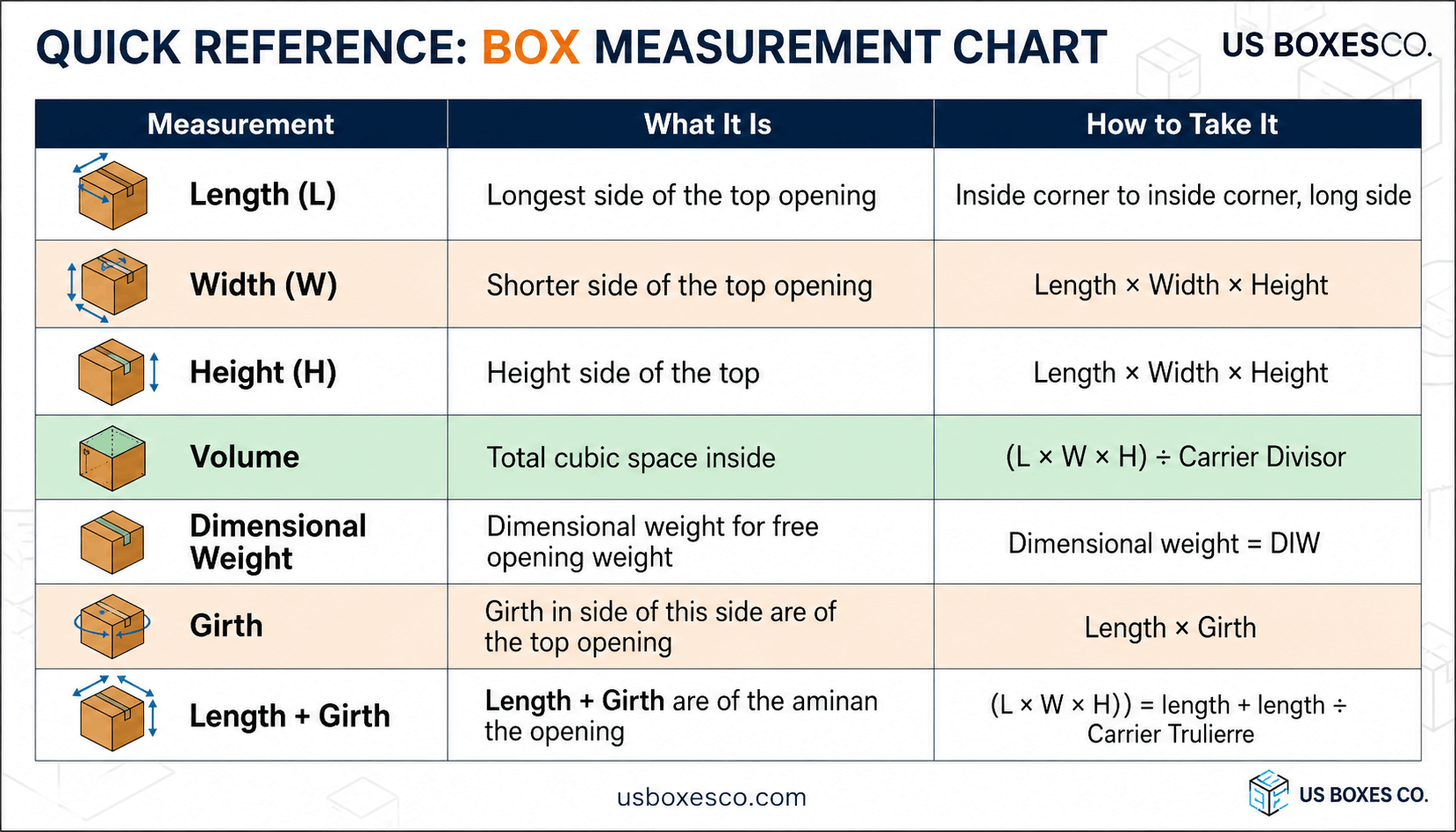
Quick Reference: Box Measurement Chart
Final Thoughts
Measuring a box isn't complicated, but doing it wrong costs real money. The dimensions decide your shipping rate, your storage cost, your custom packaging quote, and whether the product fits on the first try. Three numbers, taken from the inside of the box, in the order of length by width by height. That's the whole job.
If you're sizing up a product for custom packaging and want a second pair of eyes on the dimensions before you order, request a custom quote and our team will check the numbers with you. We'd rather catch a measurement issue at the quote stage than at the press.

Our packaging specialists design, print and ship custom boxes for brands across the USA, and share what we learn on the production floor.
What Is Kraft Paper? Types, Uses, and Why Packaging Runs on It
Pick up almost any shipping box, grocery bag, or food carton and you're holding kraft paper in one form or another. It's the brown workhorse of the packaging world, and most people use it every day without knowing what it actually is or why it's so much tougher than the paper in your printer. So here's the full picture. What kraft paper is, how it's made, the types you'll run into, what it's used for, and the honest answer to the question we get asked the most: is kraft paper waterproof?
Read Article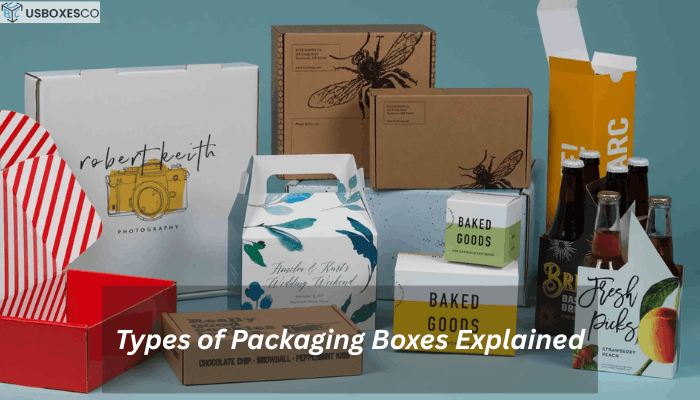
Types of Boxes for Packaging
What's the difference between a luxury iPhone box and a standard Amazon shipping carton? The answer is in the different types of boxes and their specific purposes. The need for every product is to get packed with full protection while maintaining the beauty and unparalleled sophistication to satisfy the customer's needs.
Read ArticleReady to create packaging that sells?
Tell us your box size, material and quantity. We'll send pricing and a free 3D mockup.